
Brokerage
How to Read the Order Book in Pakistan: A Complete 2026 Guide
By Muhammad Abbas · · 4 min read
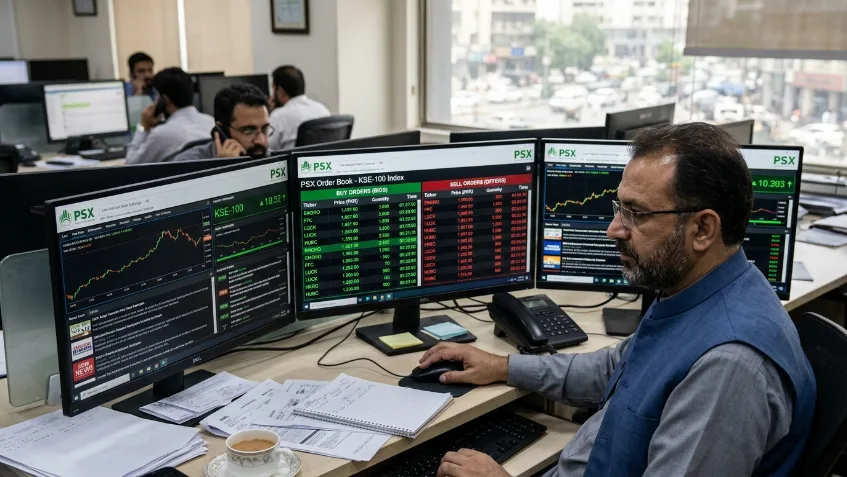
For many retail investors in Pakistan, the order book appears as a confusing wall of flashing numbers. For active and professional traders, however, it is one of the most important tools for understanding real-time demand, supply, and short-term price pressure.
An order book is a real-time electronic ledger that displays outstanding buy and sell limit orders for a specific stock, ranked by price and time. It shows where buyers are willing to step in, where sellers are prepared to exit, and how aggressively the market is positioned at any given moment.
In 2026, with the Pakistan Stock Exchange having moved to a faster T+1 settlement framework under reforms guided by the Securities and Exchange Commission of Pakistan, understanding the order book has become increasingly important for active traders. Faster settlement cycles increase capital turnover and intraday activity, making real-time liquidity analysis more relevant.
This guide is intended for active retail and semi-professional traders. In the long term, buy-and-hold investors may find limited direct application.
Defining the Core Components: Bids and Asks
The order book is divided into two primary sides that represent immediate demand and supply.
Bid Side (Buy Orders): Lists the prices buyers are willing to pay. The highest bid appears at the top.
Ask Side (Sell Orders): Lists the prices sellers are willing to accept. The lowest ask—often called the offer—appears at the top.
The current market price is typically the last price at which a trade was successfully matched between these two sides.
For a deeper explanation of trading terminology, readers may refer to the investor glossary covering core PSX concepts.

Measuring Liquidity Through the Bid-Ask Spread
The bid-ask spread is the difference between the highest bid and the lowest ask. It is one of the most important indicators of a stock’s liquidity and execution efficiency.
In highly liquid PSX stocks such as Lucky Cement (LUCK) or Hub Power Company (HUBC), spreads are often just a few paisas, reflecting strong participation and efficient price discovery.
In low-volume or illiquid stocks, spreads can widen significantly. Trading such stocks increases execution risk, as you may need to:
- Pay a premium to enter a position.
- Accept a lower price to exit.
Evaluating liquidity through the spread is an important complement to fundamental analysis, particularly in markets where trading volumes vary widely.
Analyzing Market Depth and Level-2 Data
Beyond the best bid and ask, some trading platforms (when supported) provide market depth, also known as Level 2 data. This displays multiple layers of pending orders at different price levels.
By analyzing depth, traders can identify:
- Buy Walls: Large clusters of buy orders that may act as short-term support.
- Sell Walls: Concentrated sell orders that may act as resistance.
For example, if there are 500,000 shares queued on the bid at one price and only 10,000 on the next ask level above, it often indicates near-term buying pressure, though it does not guarantee a price move.
Identifying Institutional Activity and Spoofing Risk
Larger market participants often use the order book to manage execution of sizable positions without causing abrupt price movements. However, traders must remain alert to spoofing.
Spoofing occurs when large orders are placed to create a misleading impression of demand or supply and are then cancelled before execution. This can temporarily distort market sentiment.
Experienced traders often look for persistent volume—orders that remain in the book as price approaches—to help distinguish genuine interest from temporary or deceptive signals.
The 2026 Shift: Impact of Faster Settlement Cycles
As part of post-trade modernisation efforts introduced in 2026, the PSX moved to a T+1 settlement cycle on 9 February 2026, reducing settlement from two business days to one.
For active traders, faster settlement generally means:
- Quicker release of funds after selling.
- Higher capital turnover.
- Increased intraday participation.
These dynamics can contribute to faster order-book changes and, in some cases, tighter spreads, reinforcing the importance of real-time monitoring. Implementation details may vary by broker and market segment.
Understanding Order Priority and Execution
Trade execution on the PSX follows a strict Price-Time Priority rule:
- The best price is executed first (i.e., the highest bid or the lowest ask).
- If multiple orders exist at the same price, the earliest order entered is filled first.
This explains why an order may remain unfilled even when the market trades at your price level—you may simply be waiting behind earlier orders.

Distinguishing Between Market and Limit Orders
Market Orders execute immediately at the best available prices and do not appear in the order book.
Limit Orders specify a price and remain in the order book until executed or cancelled.
Active traders often prefer limit orders because they:
- Control execution price.
- Reduce slippage.
- Protect against sudden price sweeps caused by large market orders.
Final Perspective
The PSX order book is not a prediction tool—it is a real-time map of market intent.
For active traders in 2026, reading the order book helps:
- Assess liquidity before entering positions.
- Time executions more effectively.
- Understand short-term pressure zones.
When combined with sound risk management and broader market context, order-book analysis improves decision quality without relying on price forecasting or guarantees.
Frequently Asked Questions
What does the shift to T+1 settlement mean for traders?
Faster settlement reduces counterparty exposure and releases sale proceeds sooner. For traders, this improves capital efficiency and short-term flexibility.
Why do large orders sometimes disappear suddenly?
Orders may disappear because they were filled, manually cancelled, or withdrawn after briefly influencing market perception (spoofing).
Can I see which broker placed an order?
No. The PSX order book is anonymous. You can see the price and volume, but not the participant’s identity.
What is a volume imbalance?
A volume imbalance occurs when the total buy-side quantity significantly outweighs the sell-side quantity (or vice versa). Large imbalances often precede short-term price pressures, though they are not predictive in themselves.
How do circuit breakers affect the order book?
If a stock reaches its upper or lower price limit (typically around 7.5% or Re 1, depending on the applicable price band), trading is restricted at that level. The order book may show large accumulated orders at the ceiling or floor with limited execution.

Written by
Muhammad Abbas
CEO, Bhayani Securities (Pvt) Ltd.
Need Guidance?
Book a free consultation with our licensed investment advisors.