
Brokerage
Long-Term Investing vs Short-Term Trading in Pakistan: The Definitive 2026 Professional Guide
By Muhammad Abbas · · Updated · 7 min read

The Pakistan Stock Exchange (PSX), as always, is witnessing unprecedented digital growth. With the benchmark KSE-100 index reaching historic milestones in 2026, many Pakistanis are asking: “Should I be a trader or an investor?”
While both paths (long-term investing and short-term trading) offer wealth-building opportunities, they require entirely different skill sets, tools, and mentalities. This guide dissects the mechanics of both disciplines to help you construct a resilient, profitable strategy.
Defining the Approaches
To succeed at the PSX, you must understand that investing and trading are not two sides of the same coin; they are entirely different games played on the same board.
The Long-Term Investor
Long-term investing is fundamentally an exercise in corporate ownership and macroeconomic patience. An investor does not view a stock as a blinking ticker symbol on a screen; they view it as a fractional ownership stake in a living, breathing business. If you buy shares in a premier cement manufacturer or a tier-one commercial bank, your success is tethered to their operational efficiency, national infrastructure projects, and monetary policy cycles.
- The Time Horizon: 1 to 10+ years. Investors ignore intraday noise, weekly political headlines, and temporary market corrections.
- The Analytical Engine: Fundamental Analysis. Investors spend their time dissecting quarterly earnings reports, analysing the Debt-to-Equity ratios, scrutinising the Return on Equity (ROE), and evaluating the integrity of the Board of Directors.
- The Profit Mechanism: Capital appreciation over multi-year business cycles combined with the reinvestment of cash and bonus dividends.
The Short-Term Trader
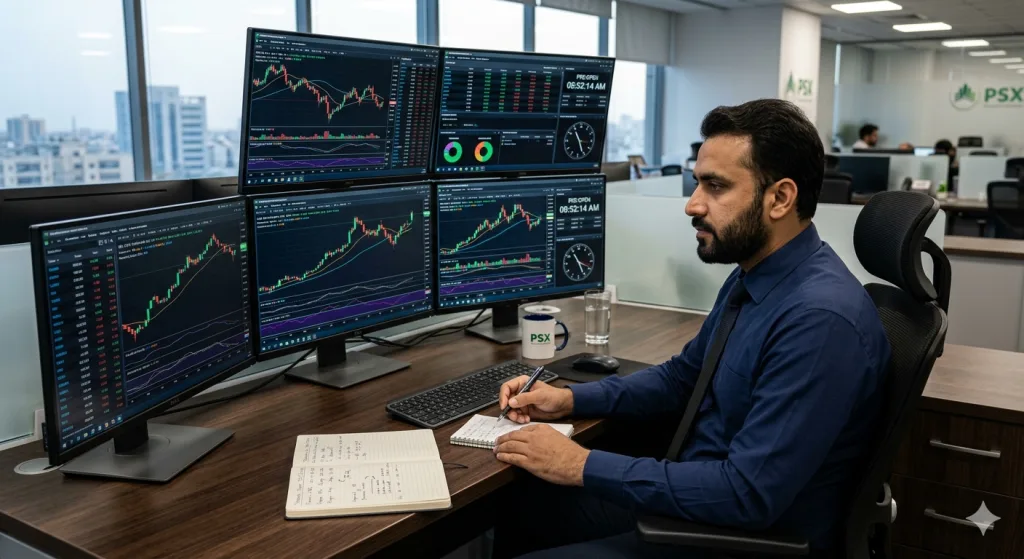
Short-term trading is the monetisation of human emotion, specifically, fear and greed. A trader recognises that in the short run, the PSX acts as a voting machine driven by sentiment, rumours, and institutional order flow. A trader does not necessarily care if a company is facing bankruptcy next year, provided the stock is experiencing a massive surge in buying volume today.
- The Time Horizon: Minutes (Scalping), Hours (Intraday), or Weeks (Swing Trading).
- The Analytical Engine: Technical Analysis. Traders rely heavily on price action, volume spikes, and technical indicators such as the Relative Strength Index (RSI), Moving Average Convergence Divergence (MACD), and Fibonacci retracements to identify precise entry and exit points.
- The Profit Mechanism: Exploiting minor price inefficiencies and directional momentum, capturing small percentage gains repeatedly while utilising strict stop-loss orders to cap downside risk.
Compounding vs Cash Flow
A misunderstanding of market mathematics often drives the allure of short-term trading. Beginners see a stock rise 7% in a single session and extrapolate that gain into unimaginable wealth. However, the true mathematical edge historically belongs to the investor.
The Power of Compounding
Compound interest is often called the eighth wonder of the world. In the PSX, compounding occurs when your capital gains generate their own gains, and your dividend payouts are used to purchase even more shares.
Consider a hypothetical scenario in which an investor allocates PKR 1,000,000 to a fundamentally robust, dividend-yielding PSX stock (such as top-tier Fertiliser or Power sector scrips). Assuming a conservative average annual return of 14% (comprising both capital appreciation and dividend yield), the portfolio does not just grow linearly.
- Year 5: The portfolio grows to approximately PKR 1,925,000.
- Year 10: The portfolio swells to over PKR 3,700,000.
- Year 20: Without adding any fresh capital, the initial investment expands to a staggering PKR 13,743,000. This wealth is generated entirely passively, requiring perhaps only two to three hours of portfolio review per quarter.
The Trading Reality
A day trader might successfully generate a 3% gross return on a PKR 1,000,000 account in a single week. However, trading is a high-friction business. To consistently achieve that 3%, the trader must execute dozens of transactions. Every single transaction incurs brokerage commissions, SECP fees, CDC charges, and capital value taxes.
More importantly, no trader has a 100% win rate. A professional trader might win 60% of their trades and lose 40%. When you factor in inevitable losses, the friction of trading fees, and the gruelling daily screen time required, the “net” annualised return of a retail trader often struggles to outperform a passive, compounded-dividend portfolio consistently.
The 2026 Taxation Framework
In 2026, the National Clearing Company of Pakistan Limited (NCCPL) and the Federal Board of Revenue (FBR) structured the tax code to penalise short-term speculation and reward long-term capital formation explicitly. Your net take-home profit is entirely dependent on your holding period and your status on the Active Taxpayer List (ATL).
The Capital Gains Tax (CGT) Slabs
For individuals registered as Active Taxpayers (Filers), the tax liability on profits scales downward the longer you demonstrate loyalty to your investment:
- Holding Period Less than 1 Year: A steep 15.0% tax on all capital gains.
- Holding Period of 1 to 2 Years: Tax reduced to 12.5%.
- Holding Period of 2 to 3 Years: Tax reduced to 10.0%.
- Holding Period of 3 to 4 Years: Tax reduced to 7.5%.
- Holding Period of 4 to 5 Years: Tax reduced to 5.0%.
- Holding Period of 5 to 6 Years: Tax reduced to 2.5%.
- Holding Period Exceeding 6 Years: Your capital gains are completely Tax-Free (0.0%).
Strategic Takeaway: If a short-term trader and a long-term investor both generate a gross profit of PKR 500,000, the trader immediately surrenders PKR 75,000 to the FBR. The investor who held the asset for six years keeps every single rupee.
For Non-Filers, the punitive measures are vastly more severe, emphasising the critical importance of operating within a “Compliance-First” brokerage framework like BSL.
Risk Management Profiles
Risk is an inescapable reality of the Pakistan Stock Exchange, but it manifests differently depending on your strategy.
Immediate Liquidity and Gapping
Traders face acute, immediate risks. Because they rely on tight margins and technical levels, an unexpected macroeconomic event, such as a sudden SBP policy rate hike or a negative IMF review, can cause a stock to “gap down” at the opening bell, completely bypassing the trader’s predefined Stop-Loss level.
Furthermore, in the 2026 T+1 environment, traders utilising Margin Trading Systems (MTS) must be hyper-vigilant regarding their account equity to avoid forced liquidations or devastating margin calls. A trader manages risk through strict position sizing, refusing to allocate more than 1% to 2% of their total capital to any single trade.
The Investor’s Risk
The investor’s primary risk is not daily price fluctuation; it is psychological fatigue. During extended bear markets, watching a high-quality portfolio draw down by 20% or 30% induces panic. The uninformed investor will capitulate and sell at the exact bottom of the market cycle, turning a temporary paper loss into permanent financial damage. The professional investor, however, views market crashes as “clearance sales.”
They manage risk through Diversification, spreading capital across uncorrelated sectors (e.g., mixing defensive pharmaceuticals with cyclical commercial banks), and employing Dollar-Cost Averaging, systematically deploying fresh capital to lower their average buy price during market dips.
The BSL Recommendation
For the ambitious 2026 investor with both long-term financial goals and an appetite for active market engagement, choosing between the two is unnecessary. The most sophisticated portfolios utilise a Hybrid approach.
The Core (70% – 80% of Capital)
This majority allocation is strictly reserved for the long game. This capital is deployed into blue-chip companies with histories of robust corporate governance, consistent dividend payouts, and strong institutional backing. This portfolio is touched rarely, allowing compounding and the sliding CGT tax scale to work their magic over the years.
The Satellite (20% – 30% of Capital)
This smaller, segregated allocation is your “risk capital.” It is used to trade technical setups actively, capitalise on earnings momentum, or exploit short-term volatility in high-beta sectors like Technology or Refineries. If the satellite portfolio suffers a loss, the core portfolio remains insulated, ensuring your long-term financial trajectory is never compromised.

The Final Verdict
Whether you intend to become a master of the order book, capturing daily momentum, or a visionary investor compounding generational wealth, the Pakistan Stock Exchange offers the infrastructure for your ambition. The only incorrect strategy is entering the market without one.
Equip yourself with the finest research, superior execution speeds, and uncompromising compliance. Open your BSL account today and take professional control of your financial destiny in 2026.
Frequently Asked Questions
Q: Does the 2026 transition to T+1 settlement benefit the investor or the trader more?
A: While T+1 settlement modernises the entire exchange, it is a massive structural advantage for the short-term trader. The ability to sell a position on Monday and have the cash settled and available for a new opportunity by Tuesday morning drastically increases capital velocity and liquidity. For the long-term investor, it simply provides an added layer of security should they face a sudden personal financial emergency requiring rapid liquidation.
Q: Can I use Fundamental Analysis for short-term trading?
A: Generally, no. Fundamental analysis tells you what to buy (the quality of the company), but it is terrible at telling you when to buy it. A company can announce record-breaking profits, yet its stock price might drop the same day due to broader market sentiment or profit-taking. Traders must rely on technical analysis to time their entries and exits.
Q: Is it advisable to hold losing trades and turn them into “long-term investments”?
A: This is one of the most fatal mistakes in the stock market, often referred to as “bag holding.” If you entered a trade based on a short-term technical setup and the setup fails, you must execute your stop-loss and exit the trade. Converting a failed speculative trade into a long-term investment simply because you refuse to accept a small loss often leads to catastrophic portfolio damage.
Q: What is the minimum capital required to implement the Core-Satellite strategy?
A: Thanks to digital democratization, you can initiate this strategy with a surprisingly low base. Utilising a Sahulat Account, an investor can begin with PKR 50,000, dedicating PKR 40,000 to a stable dividend stock and using the remaining PKR 10,000 to practice technical swing trading.

Written by
Muhammad Abbas
CEO, Bhayani Securities (Pvt) Ltd.
Need Guidance?
Book a free consultation with our licensed investment advisors.